


Amid increasingly complex environmental challenges, Sarawak possesses a strategic asset that is often overlooked: rural communities and school students who live in direct symbiosis with the natural world.
Their daily lives, inherited through traditional environmental stewardship practices, are not merely a lifestyle but the cornerstone of more holistic environmental restoration and conservation efforts.
Programs such as Rakan Alam Sekitar (RAS – Environmental Partners), Sekolah Rakan Alam Sekitar (SERASI – Environmental Partners School), and Kelab Pencinta Alam Sekitar (PALS – Environmental Lovers Club), introduced by the Department of Environment (JAS) and the Sarawak Natural Resources and Environment Board (NREB), find fertile ground when introduced into rural ecosystems.
Here, environmental education is not merely theory taught in classrooms but a lived practice internalized across generations.
Rural communities in Sarawak, particularly those residing in inland and riverside areas, possess profound Traditional Ecological Knowledge (TEK). They understand fruiting seasons, wildlife migration patterns, secondary forest management methods, and techniques for managing water resources without disrupting ecosystem balance.
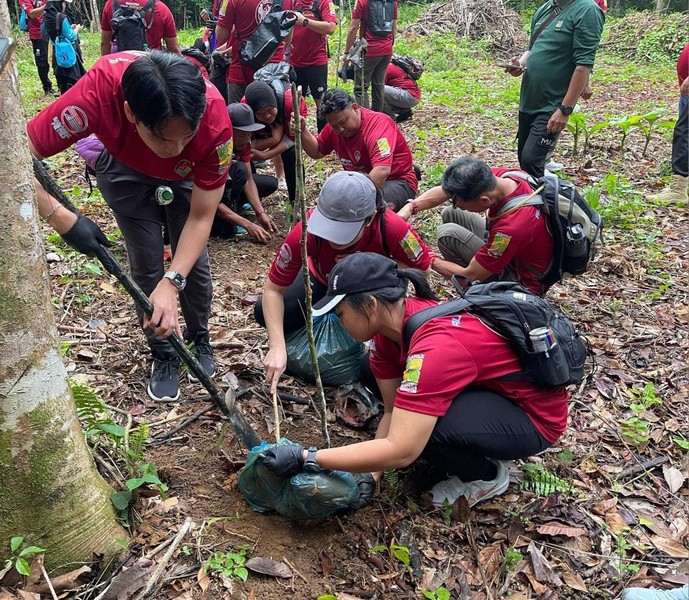
When this knowledge is integrated with environmental curricula through the PALS program, rural students become unique agents of change. They do not merely study the Air Pollution Index (API) or the carbon cycle academically; they experience and respond to them directly.
For example, students in inland areas such as Kapit or Belaga are now involved in monitoring river water quality using simple test kits, while recording data that is submitted to NREB. These activities develop practical scientific skills and strengthen their identity as genuine environmental guardians.
Grassroots Initiatives
Several grassroots initiatives have demonstrated the effectiveness of community-based approaches in rural areas.
In inland Samarahan, secondary school students and villagers have revived traditional slope stabilization techniques by planting native tree species with strong root systems, combined with simple technologies such as coconut fibre-based geotextiles to prevent soil erosion.
In the Limbang Division, Iban and Lun Bawang communities practice carefully regulated forest management systems, where areas are selectively logged in alternating patterns to allow biodiversity recovery while sustaining livelihoods. PALS students in these areas are trained to map restoration zones, monitor bird and small mammal species, and produce concise reports that serve as references at local and state levels.
At the national level, similar approaches can be seen in the Cameron Highlands, where the Temiar Orang Asli community collaborates with students on a “Forest School” program that integrates traditional medicinal knowledge with the conservation of endemic plant species.
In Sabah, the River Defenders initiative involves students and villagers in monitoring water quality in the Kinabatangan River, detecting pollution from agricultural activities, and regularly reporting data to authorities.
These models demonstrate that when rural communities and students are provided with appropriate space, training, and tools, they become not merely beneficiaries but effective and cost-efficient leaders in conservation.
Similar Initiatives Abroad
Sarawak’s success in empowering rural communities aligns with global movements that recognize the role of local populations in environmental sustainability.
In the Philippines, the Bantay Kalikasan program involves students and villagers in mangrove forest monitoring and illegal burning prevention. Residents are trained as “eco-parols” (eco-lanterns) who protect marine zones and report logging activities, echoing the spirit of PALS clubs in Sarawak.
In Costa Rica, rural communities form the backbone of environmental education models and landscape management. Through the Pagos por Servicios Ambientales (Payment for Ecosystem Services) scheme, farmers and students participate directly in reforestation, wildlife monitoring, and organic waste management, making conservation an activity that yields both economic and ecological returns.
In Japan, the Satoyama initiative revitalizes traditional landscapes where rural communities and schools collaborate to sustainably manage mixed forests, rice paddies, and irrigation systems. Students participate in collecting native seeds, restoring amphibian habitats, and learning about nutrient cycles through hands-on practice.
In New Zealand, the Māori approach of Kaitiakitanga (environmental stewardship as a sacred trust) is integrated into school curricula and ecosystem restoration programs. Rural communities and students lead native tree planting, endangered species monitoring, and waste management based on zero-waste principles.
All these examples reinforce the fact that successful conservation emerges when traditional knowledge, student engagement, and institutional support are systematically combined.
Challenges, Policy, and Government Support
Undeniably, Sarawak faces significant challenges.
A TVS report from March 2026 recorded 17 areas with API readings in the “moderate” category, while data from the Department of Statistics Malaysia (2025) shows a 34.1% increase in minor disasters, particularly floods (218 incidents).
Open burning, cross-border haze from Kalimantan, and development pressures in Kuching and Bintulu add complexity to environmental management.
However, these challenges precisely strengthen the need to place rural communities and students at the forefront.
The Sarawak Government, through NREB and JAS, has developed frameworks supporting this approach. The implementation of Environmental Impact Assessments (EIA) and Environmental Compliance Audits (ECA) are not merely enforcement tools but platforms where local community voices can be aligned with technical standards.
As of October 2025, 918 post-EIA monitoring activities and 1,857 environmental monitoring reports have been received, with strict action taken against 87 cases of non-compliance.
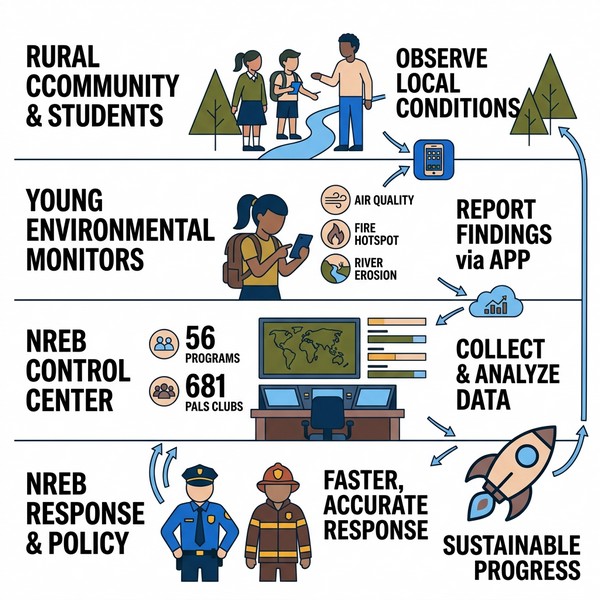
More importantly, NREB has organized 56 environmental education programs and established 681 PALS clubs out of a target of 1,459.
These initiatives serve as bridges connecting government policy with on-the-ground realities. When rural students are trained as “young environmental monitors,” they can report changes in air quality, fire hotspots, or river erosion via mobile applications linked to NREB control centres.
Integrating community data with official monitoring systems enables faster, more accurate, and inclusive responses.
Heirs to Ecological Knowledge
Rural communities and students in Sarawak are not merely victims or spectators in the narrative of environmental crisis.
They are heirs to time-tested ecological knowledge, and when combined with formal education and government support, they become the finest model for conservation and environmental restoration efforts in Malaysia.
Approaches that value traditional practices, empower students through PALS and SERASI, and integrate community monitoring with EIA and ECA frameworks have demonstrated robust results.
By learning from international models such as Satoyama in Japan, Kaitiakitanga in New Zealand, and community programs in Costa Rica, Sarawak can further strengthen its strategies.
If the state succeeds in transforming every rural student into a trained environmental guardian and every village into a biodiversity restoration hub, Sarawak will not only become a low-carbon state as targeted in the Sustainability Master Plan 2030 but also a global icon for community-based sustainability.
The future of Malaysia’s environment lies not only in laboratories or agency headquarters but along riverbanks monitored by students, in forests protected by communities, and in the minds of a generation that understands that preserving nature is preserving one’s own identity.
Through integrated collaboration among communities, schools, and government, Sarawak can prove that the path to sustainability begins at the grassroots and culminates in a living legacy for generations to come.
References
1. ABS-CBN Foundation. (2024). Bantay Kalikasan: Citizen science and environmental education programs. In ABS-CBN Foundation impact report 2023. https://www.abs-cbnfoundation.org/environment/
2. Berkes, F. (2018). Sacred ecology (4th ed.). Routledge.
3. Fondo Nacional de Financiamiento Forestal. (2025). Payment for environmental services (PSA) program. Gobierno de Costa Rica. https://www.fonafifo.go.cr/en/servicios/pago-de-servicios-ambientales/
4. Gadgil, M., Berkes, F., & Folke, C. (1993). Indigenous knowledge for biodiversity conservation. Ambio, 22(2–3), 151–156.
5. International Partnership for the Satoyama Initiative. (2022). The Satoyama Initiative: Concept and framework. United Nations University Institute for the Advanced Study of Sustainability. https://satoyamainitiative.org/concept/satoyama-initiative/
6. Jabatan Alam Sekitar Malaysia. (2023). Program Rakan Alam Sekitar (RAS). Kementerian Sumber Asli, Alam Sekitar dan Perubahan Iklim. https://ras.doe.gov.my/
7. Jabatan Perangkaan Malaysia. (2025). Statistik alam sekitar, Malaysia, 2025. https://www.dosm.gov.my/portal-main/release-content/statistics-on-causes-of-death-malaysia-2025
8. Kementerian Tenaga dan Kelestarian Alam Sekitar Sarawak. (2025). Pelan Induk Kelestarian Sarawak 2030. https://meesty.sarawak.gov.my/web/subpage/webpage_view/52
9. Kimmerer, R. W. (2002). Weaving traditional ecological knowledge into biological education: A call to action. BioScience, 52(5), 432–438. https://doi.org/10.1641/0006-3568(2002)052[0432:WTEKIB]2.0.CO;2
10. Lembaga Sumber Asli dan Alam Sekitar Sarawak. (2024). Laporan tahunan pemantauan alam sekitar Sarawak 2024. https://www.nreb.gov.my/
11. Lembaga Sumber Asli dan Alam Sekitar Sarawak. (2025, Oktober). Pematuhan alam sekitar dan pelaksanaan EIA: Ringkasan data Oktober 2025. https://www.nreb.gov.my/web/subpage/news_view/690
12. Ministry of Education New Zealand. (2017). Kaitiakitanga: Environmental stewardship in Te Whāriki. New Zealand Curriculum Online. https://newzealandcurriculum.tahurangi.education.govt.nz/kaitiakitanga/5637152867.p
13. Ottawa, C., & Kimmerer, R. W. (2020). Traditional ecological knowledge and environmental education. In The Routledge handbook of environmental education (pp. 145–158). Routledge.
14. Takeuchi, K., Brown, R. D., Washitani, I., Tsunekawa, A., & Yokohari, M. (Eds.). (2003). Satoyama: The traditional rural landscape of Japan. Springer.
15. TVS. (2026, Mac 29). IPU Sarawak meningkat, 17 kawasan pada tahap sederhana. https://www.tvsarawak.my/2026/03/29/ipu-sarawak-meningkat-17-kawasan-pada-tahap-sederhana/
16. United Nations Convention on Biological Diversity. (2008). Costa Rica: Payments for environmental services (PES) – Technical overview. CBD Financial Mechanism. https://www.cbd.int/financial/pes/costarica-pestechnical.pdf