



Nine years of YAB Datuk Patinggi Tan Sri (Dr) Abang Haji Abdul Rahman Zohari leadership in a tumultuous world demand more than mere governance; they demand vision, fortitude, and a profound sense of stewardship.
For Sarawak, a period marked by global economic volatility, geopolitical friction, technological upheaval, climate crises, and a historic pandemic has been met not with reactive hesitation but with disciplined, clear-eyed, and proactive change.
This journey represents a fundamental shift from short-term administration to strategic, outcome-focused governance, with integrity as its unwavering core.
The foundational phase was one of building resilience. It began with stabilising the state’s trajectory through institutional strength, prudent fiscal governance, and the steadfast assertion of constitutional rights within the Malaysian Federation.
Crucially, even in these early stages, the seeds of a digital future were sown.
Recognising technology as a great equaliser, Sarawak invested in digital infrastructure, most notably with the 2017 launch of Sarawak Pay (now SPay Global).
This was more than a payment platform; it was a strategic digital enhancing transparency, fostered inclusion, and built a system that would prove indispensable when COVID-19 struck, keeping small businesses and essential services afloat.
The pandemic served as a stark accelerant, reinforcing the need for a new economic pathway.
The response was the Post COVID-19 Development Strategy 2030 (PCDS 2030), a comprehensive reset.
This framework moves beyond recovery, aiming to reposition Sarawak around resilience, sustainability, and higher-value growth.
It integrates the state’s inherent strengths, its vast energy resources, land, biodiversity, strategic location, and growing institutional capacity into a cohesive plan for inclusive prosperity, spanning infrastructure, education, healthcare, and social protection.
This ambitious vision is underpinned by unprecedented financial credibility and stewardship.
Through disciplined management and strategic reforms like the State Sales Tax on petroleum products, Sarawak’s revenue has doubled since 2017.
This fiscal sovereignty has funded a new architecture of state capacity: the energy player PETROS; the development-focused Development Bank of Sarawak; the intergenerational Sarawak Sovereign Wealth Future Fund; and a strategic stake in Affin Bank.
A forward-looking carbon levy (from 2026) will further channel resources from traditional sectors into renewable energy and climate resilience, turning environmental responsibility into a funding mechanism for transition.
Growth is being deliberately channelled to enable broad-based inclusion. Strategic investments are narrowing the urban-rural divide through roads, bridges, water supply, and digital connectivity.
Air connectivity is being revolutionised by AirBorneo, with plans for a new international airport and deep-sea port at Tanjung Embang to solidify Sarawak’s role as a regional logistics hub.
Embracing sustainability as an engine of innovation, Sarawak is pioneering a circular economy, viewing waste not as a problem but as a resource. Initiatives in waste-to-energy, biomass valorisation, and biofertiliser production aim to drive rural incomes and bolster food and energy security, supported by public-private partnerships and the Climate Change Fund.

Now, the state enters an acceleration phase under the 13th Malaysia Plan (2026-2030).
The theme is execution. Sarawak’s energy leadership, anchored in its renewable hydropower strength and enhanced by PETROS, provides a competitive, low-carbon advantage for industrialisation.

Strategic priorities are clear and interconnected:
* Energy transition and low-carbon industrialisation.
* Environmental stewardship and circular economy practices.
* Advanced manufacturing and high-value downstream industries.
* Food security through modern, technology-driven agriculture.
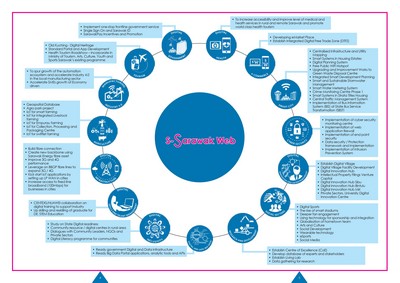
* Digitalisation and AI to boost productivity and public services.
* Logistics and gateway upgrades to connect clusters globally.
* Human capital development, supercharged by the landmark Sarawak Free Tertiary Education Scheme (FTES), ensures merit, not means, dictates educational opportunity.
2026 is thus defined as the year of delivery. It marks the pivot from planning to performance, where leadership is measured by tangible outcomes.
Effective governance is being redefined to focus on meaningful impact, with the civil service oriented toward accountability and results, a mission supported by the new Leadership Institute.
In closing, YAB Premier of Sarawak stresses that this nine-year journey has built a platform of remarkable readiness.
The true test now lies in implementation, accountability, and the tangible betterment of citizens’ lives. Achieving the PCDS 2030 vision requires a whole-of-Sarawak effort, a shared commitment across government, business, and civil society, united under the spirit of Segulai Sejalai.
It is through this unity in action that Sarawak will secure lasting prosperity, transforming resilience into a genuine renaissance for generations to come.